
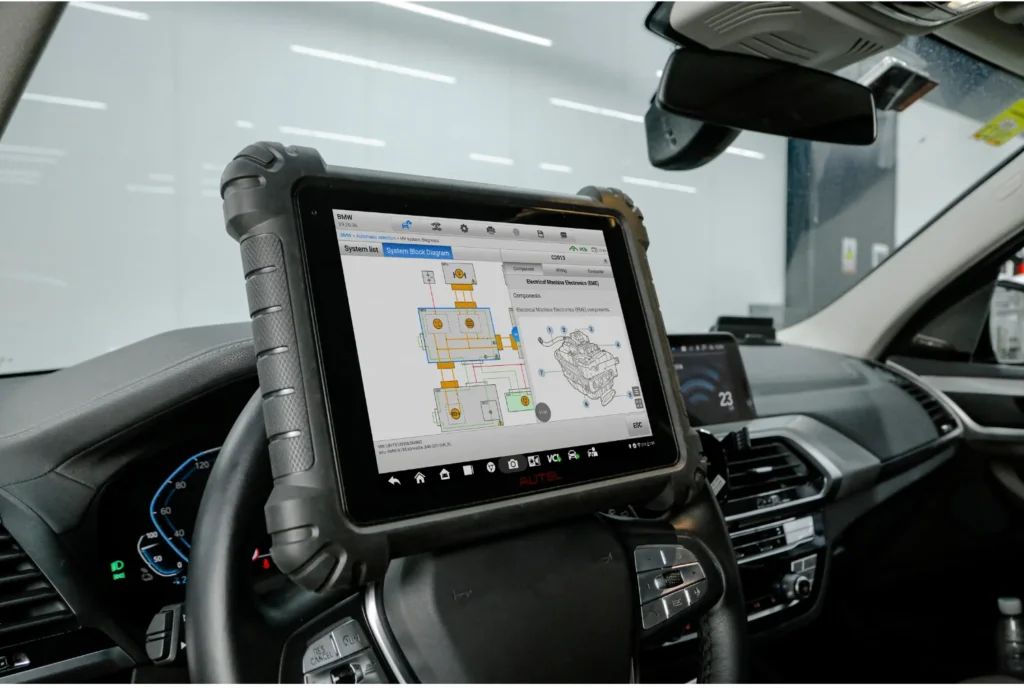
When buying a used car, what you see during a viewing is only part of the picture. A vehicle may start normally, drive smoothly and have no warning lights displayed on the dashboard, but its electronic control systems may still contain stored information that deserves further investigation.
This is why an electronic diagnostic scan is an important part of a pre-purchase car inspection.

Modern vehicles contain multiple electronic control modules monitoring systems such as the engine, transmission, ABS, airbags, climate control and other vehicle electronics. By carrying out a diagnostic scan, an inspector can retrieve fault information recorded by these modules and assess it together with the vehicle’s physical condition and road-test behaviour.
However, a diagnostic scan should not simply be treated as a search for fault codes. The important part is understanding what those codes mean in the context of the vehicle being inspected.
What Is a Car Diagnostic Scan?
A diagnostic scan involves connecting a professional diagnostic scanner to the vehicle’s onboard diagnostic system.
Depending on the vehicle, the scanner can communicate with different electronic control modules and retrieve information such as:
- Current or active fault codes
- Stored fault codes
- Intermittent faults
- Communication faults between modules
- System status information
- Available operating data from individual modules
The amount of information available varies considerably between different vehicle makes, models and systems.
During a pre-purchase inspection, this information provides another layer of assessment beyond what can be identified through visual inspection alone.
No Dashboard Warning Light Doesn’t Always Mean No Fault Codes
One misconception when viewing a used car is that there should be no electronic problems if there are no warning lights showing on the dashboard.
That isn’t necessarily the case.
A vehicle’s control modules can contain stored or intermittent fault codes without continuously displaying a warning light.
For example, a problem may have occurred previously but may not currently meet the conditions required to illuminate a warning lamp. An intermittent sensor or communication issue may also appear only under certain operating conditions.
This is why we don’t rely solely on the dashboard when carrying out an inspection.
A diagnostic scan allows us to look further into the electronic systems of the vehicle.
What Systems Can Be Checked?
The systems accessible through diagnostic scanning depend on the vehicle, but a comprehensive scan may communicate with multiple modules rather than checking only the engine ECU.
These can include:
Engine Control System
The engine control module may contain faults associated with sensors, ignition, fuel delivery, emissions, boost pressure and other engine-management systems.
Some faults may be relatively minor, while others may justify additional investigation.
Transmission Control System
On vehicles with electronically controlled transmissions, diagnostic information may help identify recorded faults involving transmission operation, sensors, actuators or control systems.
Transmission-related fault codes deserve particular attention during a pre-purchase inspection because the potential repair involved can vary considerably depending on the underlying cause.
The scan results should therefore be considered together with the physical inspection and road test of the transmission.
ABS and Stability Control
Modern braking and stability systems use wheel-speed sensors and multiple electronic components.
Faults recorded within these systems can sometimes exist even when the vehicle appears to brake normally during a short drive.
Airbag and Safety Systems
The vehicle’s supplemental restraint system may also store faults involving airbags, seat-belt components, sensors or related electronics.
Because these are safety-related systems, any relevant fault should be properly investigated.
Air-Conditioning and Climate Control
On supported vehicles, the climate-control system may record faults involving temperature sensors, flap motors, actuators and other electronic components.
This electronic information can complement a physical air-conditioning performance check.
Other Electronic Modules
Depending on the vehicle, there can be many additional modules controlling functions such as:
- Electronic parking brake
- Power steering
- Body electronics
- Lighting
- Keyless entry
- Battery management
- Infotainment
- Driver-assistance systems
This is why scanning multiple available modules can provide more useful information than simply checking the engine ECU.
Active, Stored and Intermittent Fault Codes: What’s the Difference?
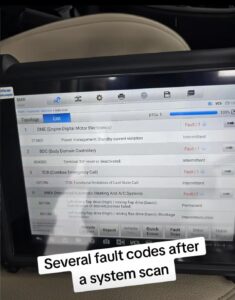
Not every fault code should be interpreted in the same way.
Understanding its status is important.
Active or Current Fault
An active fault generally indicates that the control module is currently detecting the condition associated with the fault.
These normally deserve closer investigation to determine the cause and possible repair required.
Stored or Historical Fault
A stored fault indicates that the vehicle recorded the condition previously.
However, a stored fault does not automatically mean that the component is currently defective.
The issue may have been repaired previously, may have occurred because of temporary operating conditions, or may require further investigation.
Intermittent Fault
An intermittent fault occurs when the system detects a problem only under certain conditions.
These can be particularly useful to know about during a used-car inspection because the symptom may not appear during a short test drive.
The important point is that a fault code is evidence to investigate — not automatically a diagnosis.
A Fault Code Does Not Automatically Mean a Major Repair
This is an important distinction.
Suppose a diagnostic scanner retrieves a transmission-related fault code.
That does not automatically mean:
“The gearbox is faulty and must be replaced.”
The code identifies a condition detected by the vehicle’s control system. Determining the actual cause can require additional diagnosis.
Depending on the fault, possible causes could range from electrical or sensor-related issues to control components or mechanical problems.
Therefore, during a pre-purchase inspection, our role is to identify and explain the finding so that the buyer understands what may require further investigation and the potential implications.
We prefer this approach rather than making an unnecessarily alarming conclusion from a fault code alone.
Why Diagnostic Scanning Should Be Combined With Physical Inspection
A diagnostic scanner is a powerful inspection tool, but it cannot replace a mechanic.
There are many vehicle conditions that may not generate an electronic fault code.
For example, a scan alone may not reliably identify:
- Oil or coolant leaks
- Worn suspension components
- Uneven tyre wear
- Brake disc and brake pad condition
- Previous body repairs
- Paintwork differences
- Undercarriage damage
- Abnormal mechanical noises
- Interior wear
- General physical deterioration
The opposite is also true.
A physical inspection alone cannot tell us everything stored inside the vehicle’s electronic systems.
This is why a comprehensive pre-purchase inspection should combine visual inspection, mechanical checks, electronic diagnostics and a road test rather than relying on any single method.
What Happens When We Find a Fault Code?
Finding a fault code does not automatically mean that we recommend against buying the vehicle.
Instead, we look at the finding in context.
Our mechanic considers factors such as:
- What system recorded the fault?
- Is the fault currently active or stored?
- Are there related fault codes?
- Is there a corresponding physical symptom?
- Does anything unusual appear during the road test?
- Does the finding require further diagnosis?
- What could the possible repair implications be?
This gives the buyer a more balanced understanding of the vehicle.
Some findings may simply need monitoring or clarification. Others may justify further diagnosis or repair before the buyer proceeds.
Can Fault Codes Be Cleared?
Diagnostic fault codes can generally be cleared using suitable diagnostic equipment.
However, clearing a fault code does not repair whatever caused the fault in the first place.
If the underlying condition remains, the control module may detect it again once the required operating conditions occur.
This is another reason diagnostic results should never be interpreted independently.
During an inspection, we consider the scan together with the vehicle’s overall condition and behaviour.
Can a Diagnostic Scan Prove That a Used Car Has No Problems?
No.
A vehicle returning no significant diagnostic faults does not guarantee that it is mechanically perfect.
Some mechanical problems simply do not generate electronic fault codes.
Similarly, certain developing or intermittent problems may not be present during the inspection.
A diagnostic scan should therefore be considered one part of a comprehensive vehicle assessment rather than a guarantee of future reliability.
This distinction is particularly important when buying a used vehicle.
Why We Include Electronic Diagnostics in Our Pre-Purchase Inspection
At Prepurchaseinspection.sg, electronic diagnostic scanning forms part of our broader pre-purchase inspection process.
Our inspection does not rely on the diagnostic scanner alone.
We combine electronic diagnostics with checks covering areas such as the engine and transmission, vehicle body and paintwork, undercarriage, tyres and brakes, air-conditioning, electrical systems and a road test.
When diagnostic information is found, our objective is to explain the finding clearly so that the buyer understands what was recorded and whether further investigation may be appropriate.
The objective isn’t to find reasons not to buy a car.
It is to provide more information about the vehicle’s condition so the buyer can make a better-informed decision.
Buying a Used Car in Singapore? Look Beyond What You Can See
A clean exterior, quiet engine and warning-light-free dashboard are all encouraging signs — but they don’t provide the complete picture of a modern vehicle.
Electronic diagnostic scanning allows an inspector to examine another part of the vehicle that isn’t visible during an ordinary viewing.
Combined with mechanical inspection and a proper road test, it can provide valuable additional information before you take ownership of a used car.
If you are considering a pre-owned vehicle, you can view our full pre-purchase inspection checklist to understand the different areas we inspect, or browse our real inspection cases to see examples of findings encountered during actual vehicle inspections.